
Guide for Glass Plant Workers
Glass plants are busy, demanding environments. You’ve got forklifts moving through aisles, workers on ladders, crowded work areas, and on top of all that, you’re handling one of the most unforgiving materials in manufacturing. According to the Bureau of Labor Statistics, flat glass manufacturing reports an injury rate of 5.7 per 100 full-time workers. That’s nearly double the rate for all private industries.
Glass cuts deeply. It breaks without warning. It can fail under load or thermal stress. A large sheet will act like a sail in the wind, pulling you in a direction you didn’t expect. The danger isn’t just from edges, it’s from weight and momentum.
The nature of glass injuries has shifted over the years. Cuts are still a concern, but crush injuries from falling or tipping glass have become one of the leading causes of fatalities in this industry. Weight is every bit as dangerous as sharpness.
Calculate Weight Before You Move
A lite that looks manageable from across the room can easily exceed safe single-person carry limits. Never guess. Use this formula before any lift:
Weight (lb)= Area (ft²) x Thickness (in) x 12.2
Weight (kg)= Area (m²) x Thickness (mm) x 2.5
Once you know the weight, use the table below to decide how to proceed:
These are the line between a safe lift and a serious injury. If you’re not sure, calculate again or leave the glass in place. If the number comes back over 110 lb (50 kg) and there’s no mechanical equipment available, do not move the glass.
Manual Handling: Do It Right
Even with automation becoming more common, workers in glass plants still handle lites by hand every day. Done right, it’s manageable. Done wrong, it’s one of the most injury-prone tasks in any manufacturing environment. OSHA data shows that nearly one-third of all serious workplace injuries involve musculoskeletal disorders, sprains, strains, and back injuries, and manual glass handling puts you at risk for all of them.
The biggest mistake people make is treating glass like it looks lighter than it is and moving before they’ve thought it through. Before any glass moves, stop and run through this checklist:
- Calculate the weight— never estimate.
- Inspect the pathway— clear all obstructions before lifting, not during.
- Communicate— if it’s a team lift, agree on every step before anyone touches the glass.
- Restrict the area—rope off aisles and use flashing lights if available.
Safe Carrying Habits
- Carry glass vertically to minimize risk of breakage.
- Carry only one lite at a time.
- Never try to squeeze through a tight space while carrying a glass lite.
- Don’t set glass down in a temporary or unsecured location while sorting.
- Know your own lifting limit.
Two-Person Lifts
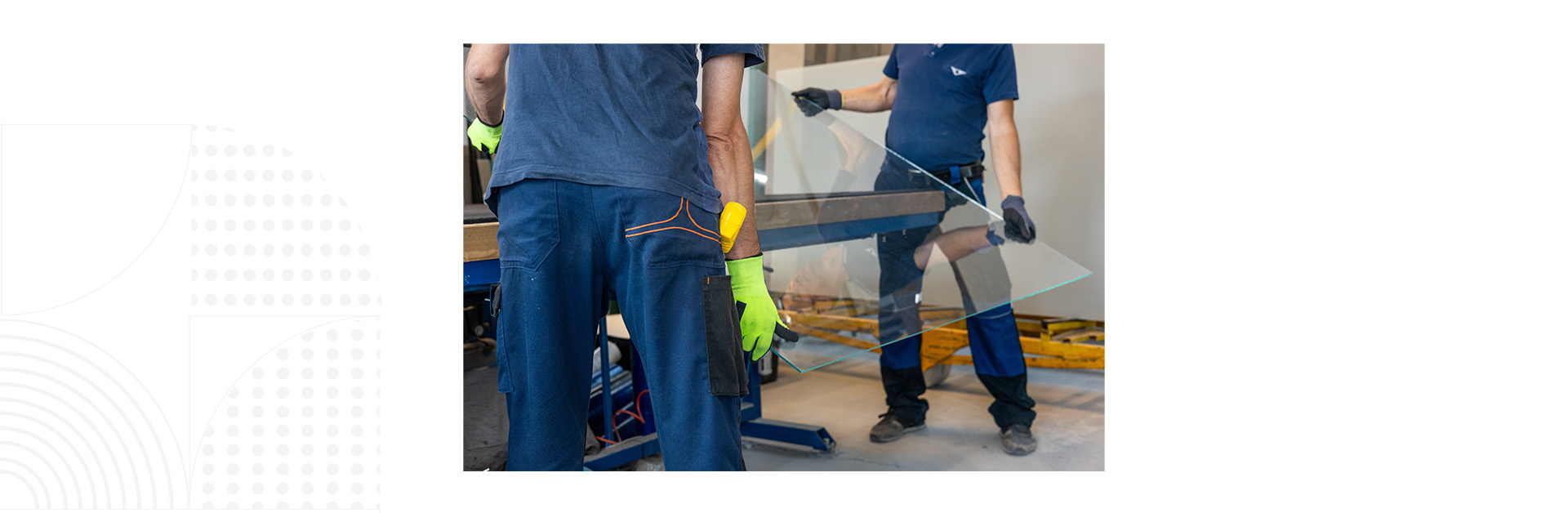
When a lift requires two people, communication is everything.
- Use suction cups to establish a firm, consistent grip on both sides. This removes reliance on friction alone.
- Position yourselves on opposite sides of the lite for balanced weight distribution.
- Move at the same pace. Call out your movements.
- Never rush.
- If a lite starts to fall, step clear. NEVER try to save it.
Mechanical and Automated Systems
Automation has dramatically reduced the frequency of direct human contact with glass in manufacturing environments. Vacuum lift systems, in particular, have changed the safety equation: rather than workers fighting against weight, friction, and fatigue, the machine takes on the load. Research shows that vacuum lifts reduce lower back compression forces by up to 39% and shear forces by up to 25%. Companies that have implemented comprehensive ergonomic programs including vacuum lifts report 60–80% reductions in back injuries within the first year.
With a vacuum lift system, only one operator is needed to control the lift remotely. That keeps two or three additional workers out of the immediate danger zone, away from sharp edges, and out from under or around the load. The suction provides a consistent, controlled grip and modern systems include audible warnings before vacuum pressure drops to unsafe levels, backup holding systems, and automatic shutoffs.
Automation can introduce its own hazards. Robotic systems can move at speeds and with forces that are dangerous to anyone nearby. A vacuum system failure on a heavy sheet can be catastrophic. To prevent injury in the shop, in the United States, ASME BTH-1 governs below-the-hook lifting devices, including vacuum lifters. These standards cover design requirements, testing protocols, and operational limits that equipment must meet. Know the systems you work around, know the warning signs of equipment issues, and never assume a machine is safe because it’s running quietly.

Personal Protective Equipment
Personal Protective Equipment (PPE) is the last line of defense, not the first. PPE is required for everyone on the floor. Here’s what you need and why it matters:
Pay particular attention to the areas where cuts cause the most serious harm: the neck, upper inner arm, inner wrist, and upper inner thigh. These zones must be covered before you touch any glass.
Common PPE mistakes to avoid:
- Removing gloves because they feel hot or uncomfortable.
- Rolling up wrist guards like a sleeve.
- Wearing prescription glasses without safety eyewear on top.
- Reusing PPE that is damaged or worn out.
Responsibilities on the Floor
Safety in a glass plant isn’t just a personal commitment; it’s a shared one. Employers and employees both have a role to play.
For Employers
- Start safety training on day one and repeat it regularly.
- Conduct regular walkthroughs to audit compliance with OSHA standards.
- Inspect glass racks at least annually for structural defects.
- Take every near-miss seriously. A near-miss is a warning that something in the system is at risk of failing.
- Maintain an up-to-date Emergency Action Plan.
- Enforce PPE compliance consistently.
For Employees
- Follow all procedures even when no one is watching.
- Know their own lifting limits and don’t push past them.
- Communicate with your lifting partners before, during, and after every move.
- Hold teammates accountable.
- Report unsafe conditions through your facility’s established channels.
- Keep work areas clear of clutter.
Resources
National Glass Association. “MyGlassClass: Online Safety Courses.” https://www.myglassclass.com
National Glass Association. NGA Employee Safety Guide.
Occupational Safety and Health Administration (OSHA). “Safety Standards, Training and Hazard Guidance.” https://www.osha.gov
Installix. “Glass Weight Calculator.” https://installixwnd.ca/tools/glass-weight-calculator

