

Glass handling is one of the systems that determines whether a glass line hits its numbers or falls short. It feeds every downstream process, so if it’s slow, inaccurate, or unreliable, the whole plant feels it. This article walks through the latest system updates and the engineering details a plant manager, process engineer, or plant owner would want before selecting a system.
What the Crane Loading System Does
The Billco Crane Loading System is a fully automated solution for storing, organizing, and feeding glass to a cutting table. It retrieves single sheets of glass from storage racks and delivers them to the cutting line without operator intervention. The system integrates with fixed racks, automated compact drawer storage, or both, and it’s flexible enough to load multiple cutting tables from a single crane.
That means:
- Labor to load the cutting table is eliminated.
- More sheets cut per shift, because the crane delivers a continuous flow of glass rather than depending on a worker’s cycle.
- Inventory is always current, since every rack position is tracked by the system.
- Yields improve, because the crane can handle larger, heavier sheets with less risk of breakage than manual handling.
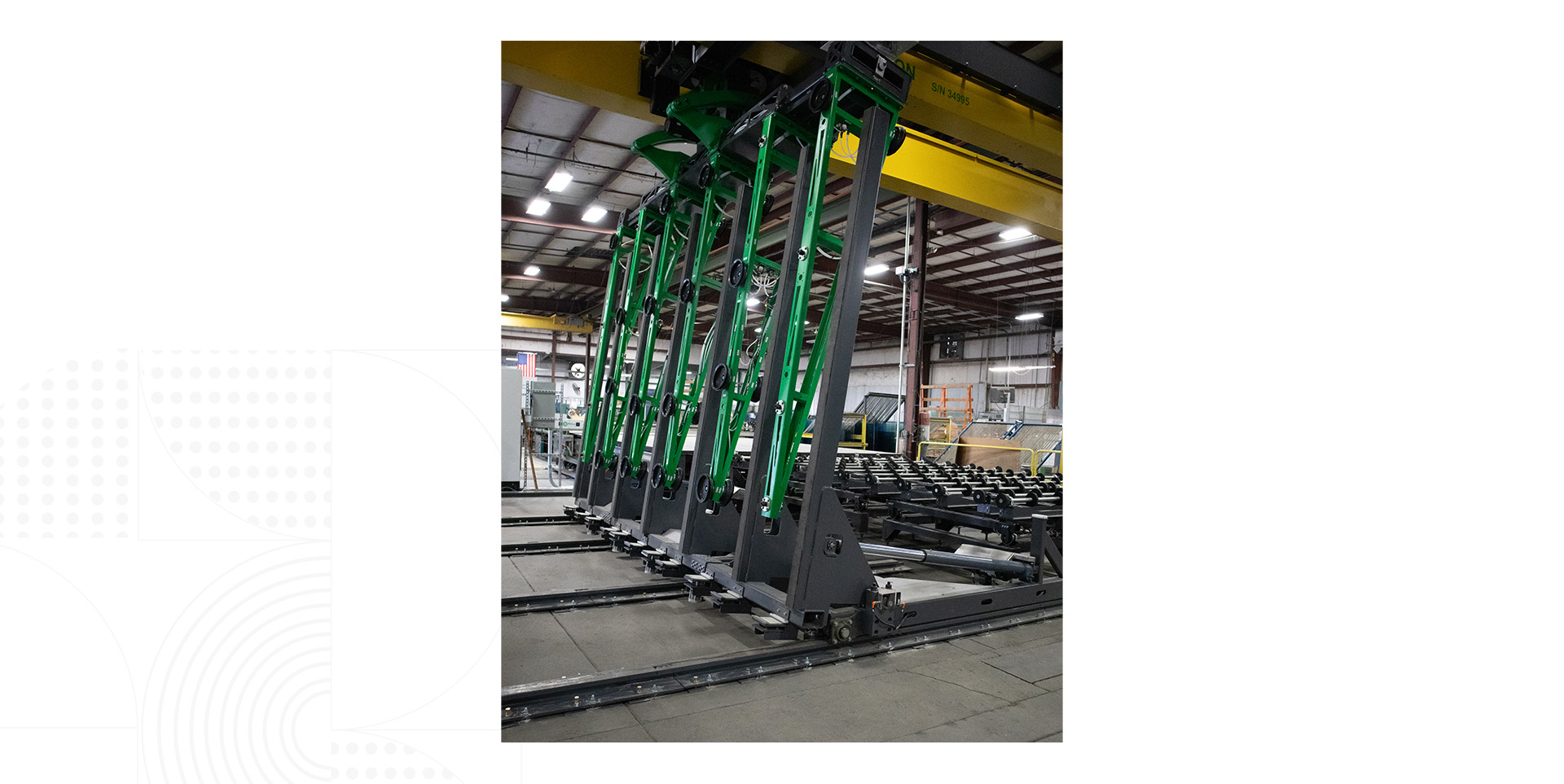
Latest Updates
Billco’s current crane platform includes three notable engineering upgrades over prior designs:
- 7-Axis Servo-Controlled Motion with Rack-and-Pinion Drives
The crane now runs on a 7-axis, fully servo-controlled platform. Where older systems relied on simpler motor control and, in some cases, pneumatic actuation, servo control on every axis means each motion — bridge travel, trolley travel, lift, tilt, rotation, and grab positioning — is closed-loop and independently tunable. Combined with rack-and-pinion drives.
That means:
- Faster acceleration and deceleration without sacrificing positioning accuracy, since rack-and-pinion drive doesn’t rely on friction/traction the way wheel-on-rail systems do.
- Repeatable, precise positioning cycle after cycle, which matters when you’re stacking tight tolerances across thousands of cycles per shift.
- Smoother motion profiles, reducing mechanical stress on the crane structure and on the glass itself.
- 270-Degree Rotating Vacuum Frame
The vacuum grab frame now rotates through 270 degrees, a significant increase in flexibility over fixed-orientation grabs. This matters for a few concrete reasons:
- Multi-side picking. The crane can retrieve glass from racks oriented on more than one side of the aisle without needing to reposition the entire bridge assembly or reconfigure rack layout.
- Tight-space handling. In plants where bay width or rack density is a constraint, a rotating frame lets the crane thread glass into and out of positions that a fixed-orientation grab couldn’t reach cleanly.
- Seamless transfer to the conveyor or cutting table. Because the frame can rotate to match the receiving equipment’s orientation, hand-off to the conveyor or cutting line doesn’t require an intermediate repositioning move, which is where a lot of cycle time gets lost in older designs.
This pairs directly with Billco’s existing Decoupled Tilt Arms option, which lets the tilt arms traverse independently to create an extra staging position, useful when the crane is picking continuously from the back of the bay and you want a standing piece of glass always ready at the cutter.
- Simplified Wiring: WiFi I/O with HMI Touchscreen Control
Cabling and slip-ring systems are a common maintenance headache on any bridge crane; they’re exposed to constant flex cycles and are a frequent source of downtime. The updated system addresses this two ways:
- Point-to-point wireless I/O eliminates a large share of the signal wiring that would otherwise run along the bridge and trolley, reducing the number of physical connections that can fail, fray, or need periodic inspection.
- An HMI touchscreen gives operators and maintenance staff direct, intuitive control and diagnostics at their fingertips.
Together with Billco’s existing use of laser transducer position sensing, this reduces the total count of maintenance-prone components on the crane and shortens both installation time and troubleshooting time when something does need attention.
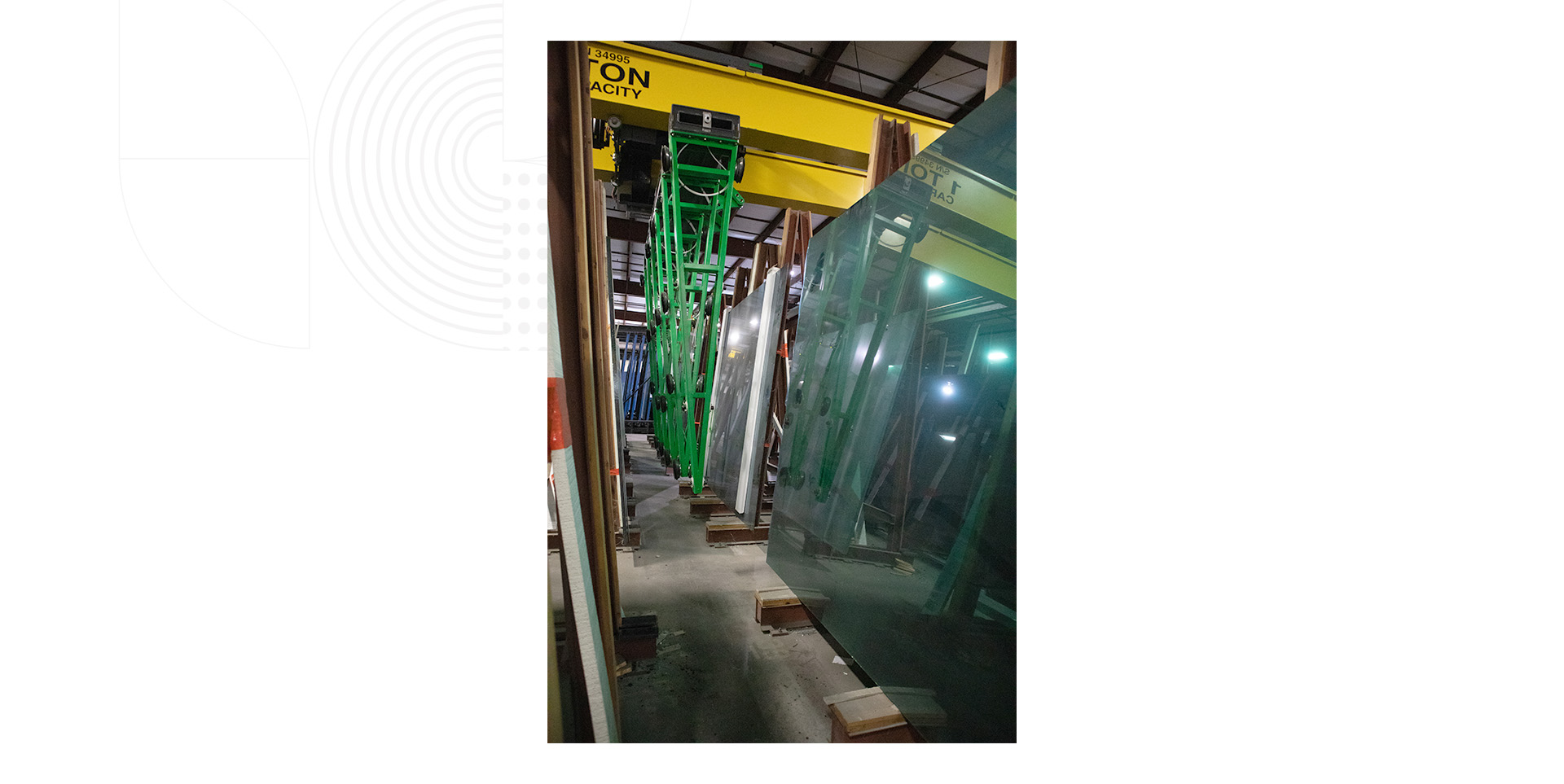
Built Around Your Shop
No two glass plants are laid out the same way, run the same product mix, or have the same bottlenecks, which is why Billco doesn’t sell a fixed, off-the-shelf crane. Every system is custom engineered around the customer’s building, process, and equipment. This is arguably the most important thing to understand before selecting a system: the crane is designed to fit your shop, not the other way around.
What gets customized:
- Rack and floor layout. Billco engineers work directly with your team to design the rack and equipment layout that maximizes glass storage while minimizing crane travel time.
- Storage density and type. Standard open rack layouts, single-sided L racks, double-sided A racks, or dense rack systems for plants where floor space is the binding constraint.
- Crane span and reach. Standard spans run up to 50 feet, with wider spans engineered on request.
- Grab and tooling. Vacuum grab size and configuration, tilt arm behavior (fixed vs. decoupled/traversing for an extra buffer station), and extended grabs for jumbo-sized glass are all selected based on your sheet sizes and handling needs.
- Provisions for future equipment. If you know you’ll want edge deletion or other downstream processes eventually but aren’t ready to invest now, Billco can build in provisions so that equipment can be added later without reworking the crane.
- Retrofit vs. new build. Billco can install a new system on most existing rails, retrofit an older Billco crane with new electrics, controls, and mechanical components, or design a complete new structure, whichever fits your budget and timeline.
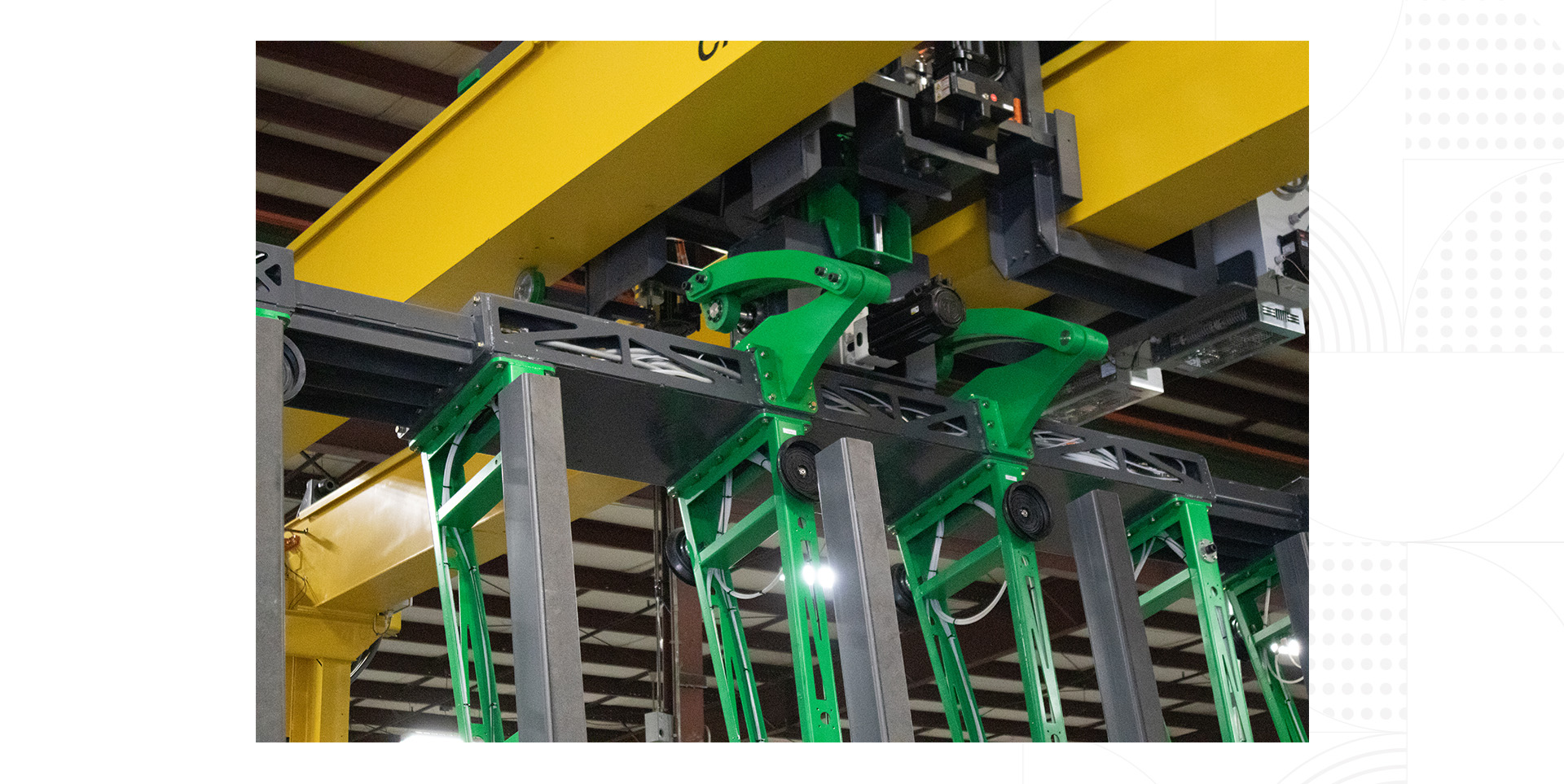
In short: capacity, footprint, throughput target, glass type, and building geometry are all inputs to the design, not constraints you have to work around after the fact.
Integration with Other Equipment
A crane loading system doesn’t operate in isolation; it’s the link between glass storage and the rest of your line, so integration flexibility matters as much as the crane’s own mechanics.
Cutting equipment. Billco crane systems interface with Billco’s own CNC/XYZ cutting tables (new or existing) as well as CNC glass cutting equipment from other manufacturers. A single crane can load multiple cutting tables, which is useful in plants running parallel cutting lines for different product types or sizes. The crane’s control system communicates directly with the cutting line’s control and optimization software, so glass is delivered in the sequence the cutter actually needs it — not just pulled in storage order.
Different glass types and sizes on the same system. Because the crane accommodates a range of thicknesses (roughly 2mm–19mm) and sheet sizes (up to 130″ x 204″ in current configurations), a single system can typically be engineered to handle your full product mix — coated and uncoated, standard and jumbo — rather than requiring separate equipment per glass category. Pack thickness sensors let the crane pre-calculate glass volume before retrieval, which helps keep cycle time consistent even as pack composition varies.
Control architecture. A stand-alone control system lets the crane operate independently of the cutting line when needed, for example, during cutter maintenance or changeover, rather than tying crane operation to a single piece of downstream equipment.
The practical takeaway: if you’re running mixed equipment, a mix of cutting technologies, multiple lines, or plan to add washing or other processes later, that’s a normal starting point for a Billco design conversation, not an obstacle.
Frequently Asked Engineering Questions
What glass sizes and thicknesses can the system handle? The system accommodates glass thickness from roughly 2mm up to 19mm, and sheet sizes up to 130″ x 204″. Billco customization works around your specs; speak to a Billco solutions specialist for custom sizes. One system can typically be configured to cover a plant’s full range of sheet sizes rather than requiring separate equipment per size class.
What crane spans are available? Standard spans run up to 50 feet, with wider spans available for larger buildings or higher-capacity layouts.
Can it run on my existing crane rail, or does it need its own structure? Billco can often install a crane loading system on existing rails already used by a general handling/stocking crane, which reduces the installation investment. Configurations include:
- Top running, sharing or paralleling an existing rail
- Single-leg gantry
- Double-leg gantry
- Running on your existing crane and existing crane rail
Billco engineers will work with your team to lay out racks and equipment to maximize glass storage while minimizing crane travel time.
Can it work with a rack system I already have, or ones I fabricate myself? Yes. The crane can retrieve glass from single-sided L racks or double-sided A racks.
Will it integrate with my existing cutting table? Billco has interfaced its crane systems with most manufacturers’ glass cutting equipment, in addition to Billco’s own CNC/XYZ cutting tables (new or existing). Multiple cutting tables can be loaded from a single crane system.
How does it handle coated glass (e.g., soft-coat Low-E) without damaging the coating? The system uses a “pass-through” lay-down mode that protects the coated side during placement, combined with a soft-glass set-down mechanism that protects the non-coated side. Non-marking vacuum cups (durable vinyl, on a structural steel frame) further reduce the risk of surface damage or marking during pick-up.
What safety systems are built in? Standard safety equipment includes movement alerts, safety interlocks, and end-of-travel switches for both bridge and trolley. The wireless pendant option keeps operators at a safe distance from moving glass during any manual intervention.
How reliable is it, and what does maintenance look like? Billco uses AC motors and drives, which reduce the periodic adjustments associated with other motor types, and vacuum generators rather than vacuum pumps, giving faster vacuum response with fewer wear parts and no lubrication requirement. Position feedback via laser transducers reduces reliance on multiple discrete mechanical and electrical sensors, which lowers the number of components that can fail and speeds up both installation and diagnostics. Replacement parts are stocked at Billco and Billco provides 24 | 7 | 365 parts and technical support.
How much energy does it use? The system is designed to run on comparatively little energy relative to its throughput, a function of the AC drive system and vacuum generator approach rather than pneumatic or hydraulic actuation.
Can the system grow with my plant? Yes. Additional glass storage racks can be added to expand a system after installation. Billco has engineered systems with as many as 75 glass storage racks, and layout provisions (like sizing for future edge deletion equipment) can be planned into the initial design even if that equipment isn’t purchased on day one.
What if floor space is extremely tight? Billco offers dense rack systems, where racks index to open crane access only where and when needed, saving significant floor space compared to fixed-aisle rack layouts.
What’s the real-world throughput I should expect? Based on Billco’s cycle time analysis of rack-and-pinion crane systems (96″x130″ and 108″x144″ glass), average cycle time was about 108 seconds per pick-and-place. At 85% efficiency across a 3-shift, 5-day, 50-week operation, that supports roughly 33,600 sq ft of potential raw glass per day, or about 13,176 sq ft per 8-hour shift after accounting for inefficiency — comfortably covering a 20,000–24,000 sq ft/day production target across two 10-hour shifts.
What optional equipment should I consider?
- Increased crane span
- Decoupled tilt arms (adaptive loading / extra buffer station)
- Extended grab for jumbo-sized glass
- Remnant Storage System
- Ultra Series Glass Cutting Solution
Bottom Line
The fundamental benefit of the Billco Crane Loading System hasn’t changed: eliminate manual loading labor, keep the cutter continuously fed, protect glass during handling, and give you accurate real-time inventory. What’s changed with the current generation is the precision and flexibility of the motion system and the simplicity of keeping it running. For a plant evaluating a new install or a refurbish of an older system, those upgrades translate directly into faster cycles, fewer failure points, and less unplanned downtime, the things that actually move the needle on cost per square foot.
For free layout consultation, analysis specific to your glass size, or an installation quote, contact Billco’s Solution Specialsits: 724.452.7390

