
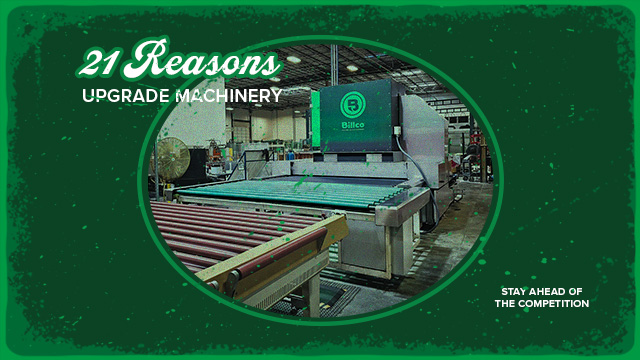
If your glass processing equipment is holding back your productivity, quality, or growth, it is time to take a good look at what updating can do for your operation. Whether you are running equipment that is aging out or just wondering if there is a better way to produce, the following reasons help you recognize when replacement has become necessary.
Safety and Compliance
- Improved Operator Safety
The glass industry carries inherent risks, such as sharp edges and heavy lites. A single serious workplace injury can cost a company far more than a machinery investment: OSHA estimates the direct and indirect costs of a single lost-time injury can exceed $40,000, and that does not account for the human toll on your workforce or the disruption to your operation.
Modern glass machinery is engineered with operator safety at the forefront. Features such as advanced blade guards, automated shutoffs, and automatic handling systems significantly reduce the need for manual glass contact. Reduced human touchpoints mean fewer cuts, strains, and acute injuries. The cost of upgrading is not just a capital decision; it is a risk decision.
Review your OSHA logs for the past few years. If you see recurring injuries such as cuts, strains, or near-misses, trace them back to the specific machine interaction. Frequent incidents tied to the same station are a clear signal that the equipment’s safety design has fallen behind.
- Safety Standards Compliance
OSHA regulations and industry safety standards are not static; they evolve to reflect new understandings of workplace hazards, equipment capabilities, and injury data. Standards set a baseline expectation for guarding, noise levels, dust exposure, and machine safety that older equipment may no longer meet.
Operating non-compliant machinery exposes your facility to costly fines and mandatory shutdowns. New equipment is designed and tested to meet today’s compliance benchmarks, giving you confidence that your facility is operating within the law. Visit OSHA to verify if your equipment meets current standards.
Pull documentation and safety certifications for your equipment and compare them to the current OSHA standards. If your guards, noise ratings, or emergency stop placements predate the current standards, it’s time to look into replacement solutions, add-ons, and repairments.
- Reduced Unplanned Downtime
Aging equipment can fail unpredictably. A single unplanned shutdown can disrupt production schedules, delay customer orders, and create costly emergency repair situations. Newer machines come equipped with on-screen predictive maintenance alerts and remote diagnostics capabilities that give operators and managers early warning of developing issues before they become full stoppages.
Rather than reacting to failures, your team can plan maintenance proactively, scheduling it at a time that minimizes production impact. The shift from reactive to predictive maintenance is one of the most tangible operational improvements a facility can make.
Track your unplanned downtime events for a few months: date, duration, cause, and cost of repair. If your equipment is going down more than once a month unexpectedly, or if individual incidents routinely exceed hours, the reliability of your machinery is costing you money.
Quality and Output
- Superior Edge Quality
Edge quality in glass is not merely a cosmetic issue. Poor grinding or seaming introduces micro-fractures along the edge that create stress concentration points, leading to breakage during tempering, in handling, or ultimately in the field at a customer’s jobsite. Field failures are expensive: they generate warranty claims, require replacement material and labor, and damage your reputation with the glaziers and contractors who depend on you.
Modern grinding and seaming equipment produces cleaner, more consistent edges with tighter geometry control. The downstream effect is fewer breakages during tempering, better yield from high-value coated or specialty substrates, and a measurable reduction in field complaints.
Inspect a sampling of edges under a magnification after processing. Visible chipping, uneven seam width, or rough texture are warning signs. If you are seeing elevated breakage rates during tempering, especially on coated and low-e glass, edge quality is likely a contributing factor.
- Improved IG Seal Integrity
Seal failure is one of the leading causes of warranty claims in the glass industry. A failed IG unit that fogs between the panes means a callback, replacement material, field labor, and a customer who remembers the problem more than they remember the installation. In volume, seal failures can represent a meaningful warranty liability.
Modern IG assembly equipment applies primary and secondary sealants with greater consistency and precision than older systems, ensuring proper coverage and adhesion across the full perimeter of every unit. The result is fewer failures in the field, fewer warranty callbacks, and a stronger reputation for quality with the contractors and dealers who rely on your product.
Monitor your warranty claim data and flag any callbacks attributed to seal failure or fogging. A rate below one or two percent of units shipped is cause for concern. Inspect sealant bead cross-sections on your line periodically; inconsistent width, voids, or coverage gaps are signs that your equipment’s sealant application is not holding tolerance.
- Cleaner Glass Entering Tempering
Contamination on the glass surface going into a tempering furnace, such as oil from handling, debris, or residue from the cutting process, can cause inclusions, hazing, or roller marks that ruin the finished product. Modern Billco washers deliver more consistent, thorough cleaning than older washer designs, ensuring glass enters the furnace in the best possible condition. Fewer contamination-related rejects from the furnace means better yield and fewer surprises at the end of the line.
Pull a month of tempering reject logs and categorize the cause of each failure. If inclusions, surface haze, or roller contamination appear consistently, trace them back to the washer. You can also run a clean lite through your washer and inspect it immediately after drying under raking light; any residual film, streaking, or spots indicate the washer is not performing adequately.
- Reduced Scrap and Waste
Worn cutting wheels, inconsistent scoring pressure, and aging mechanics can contribute to breakage and rework. Every rejected lite represents raw material cost, labor, and time that cannot be recovered.
Upgraded equipment delivers tighter tolerances and more consistent results, reducing the material waste that quietly erodes your margins every single day. Billco’s Remnant Storage Solution addresses one of the most overlooked sources of waste in glass fabrication: the partially used sheet. Rather than discarding cut-down lites or tracking them manually, the remnant system stores and catalogs usable pieces, making them available for future jobs and reducing the frequency with which whole sheets are opened unnecessarily.
Calculate your scrap rate as a percentage of total glass input for the past six months. A rate above three to four percent on standard clear, or above two percent on coated products, suggests your cutting or handling equipment is underperforming. Track whether scrap incidents cluster around a particular machine or process step.
Productivity and Throughput
- Increased Speeds and Throughput
Modern CNC glass cutting systems operate at speeds that can be substantially faster than equipment produced even ten to fifteen years ago. The result is more lites per shift without adding labor.
While Billco machines are designed to last decades and may still deliver competitive performance, the question is whether you’re keeping pace with order volume and customer lead time expectations. Signs that your speeds may be falling behind include growing backlogs, overtime required to meet schedules, or customers pushing for faster turnaround. If your line speed is a bottleneck, it is worth benchmarking your current throughput against what today’s equipment can deliver; the productivity gap may be larger than you expect.
Calculate your actual lites per shift over the past 30 days and compare it to your theoretical capacity. If you are consistently running overtime, declining orders, or extending lead times to manage backlog, your throughput ceiling is a business constraint. Request a performance comparison from your equipment supplier based on your actual product mix.
- Automated Handling
Every time a piece of glass is manually handled, there is risk of breakage, injury, and surface contamination that can affect downstream processing or finished quality. Manual handling between stations is one of the most common sources of both damage and ergonomic strain in glass fabrication facilities.
Automated loading, unloading, and transfer systems reduce the number of times glass is touched between processes. This protects your product, reduces the physical demands on operators, and allows your workforce to focus on higher-value tasks rather than repetitive material movement. For facilities running high volumes, the reduction in handling-related breakage alone can represent significant material savings.
Walk your line and count the manual touch points between cutting and shipping. If operators are repositioning glass more than two or three times per lite, you have an automation opportunity. Track breakage incidents by cause, if handling is a leading category, the cost of automation pays for itself faster than most capital investments.
Financial and Operational Performance
- Lower Energy Consumption
Energy costs are a significant and unavoidable component of glass processing operations, particularly in tempering and laminating, where equipment runs at high temperatures for extended periods. Older tempering furnaces consume substantially more energy per cycle than modern equipment, due to improvements in insulation, heating element efficiency, and control systems that minimize heat loss during idle and transition periods. If your furnace is more than fifteen years old, it’s almost certainly costing you more per lite than a modern replacement would.
The same principle applies to laminating lines, where autoclave and oven energy consumption has improved significantly with better cycle controls and more efficient heating elements. On the washer side, older designs run large volumes of continuously heated water, while modern washers use recirculated water systems and more efficient heating, reducing both water and energy consumption. These savings are not dramatic on any given day, but compounded over a full operating year, they represent real dollars that flow directly to your bottom line and they make your operation more defensible in a market where energy costs and sustainability increasingly matter to customers.
Pull your utility bills for the past twelve months and calculate your energy cost per lite produced. If you do not track production against energy consumption, start now. Compare your tempering furnace energy consumption spec from the manufacturer data plate to the published specs on current equipment, the difference in kWh per cycle often tells the story clearly.
- Lower Maintenance Costs
The cost curve of maintaining aging machinery tends to accelerate over time. Parts become harder to source, repair intervals shorten, and technician time compounds. What began as manageable upkeep can quietly become a significant annual expense.
Modern Billco equipment features a reduced and simplified parts list, which means fewer unique components to stock, easier sourcing, and faster repairs when they are needed. All Billco machines come with lifetime 24 | 7 | 365 support, a reflection of the confidence built into our construction and meaningful protection for your investment. When you factor in lower parts costs, warranty coverage, and reduced repair frequency, the total cost of ownership on new Billco equipment compares favorably to the ongoing maintenance burden of aging machinery.
Total your maintenance spending, parts, labor, and outside technician costs, for the past two years. If annual maintenance on a single machine is running more than ten to fifteen percent of what a replacement would cost, the economics of continued upkeep are working against you. Factor in the hidden cost of production delays caused by those repairs as well.

- Reduced Labor Costs
Older equipment often requires more operator attention per unit, more manual adjustments, more intervention during processing, more inspection steps to catch the inconsistency that newer machines eliminate automatically. The result is a higher labor cost per lite, even when wages stay constant.
Modern automated systems produce more units per labor hour while simultaneously reducing rework and inspection overhead. In a market where labor is expensive and scarce, reducing the labor content per unit is one of the most impactful productivity levers available to a glass fabricator.
Calculate your total labor hours per thousand square feet of glass processed and track it over the past two to three years. If the trend is flat or rising, your labor efficiency is not improving. Benchmark your labor cost per lite against industry norms; if you are significantly above average, your equipment-to-labor ratio is likely out of balance.
- Reduced Water and Chemical Costs
Glass washing is a required step in most fabrication workflows, and the operating costs of older washer designs, in water consumption, heating energy, and detergent usage, can be surprisingly high when tracked carefully. Many facilities run their washers without a clear picture of what they cost per unit processed.
Modern Billco washers use recirculated water systems with optimized filtration and more precise detergent dosing, substantially reducing both water usage and chemical expenditure. For high-volume operations, these savings compound quickly across a full year of production. They also support environmental and sustainability goals that are increasingly relevant to commercial customers and building projects pursuing green certifications.
Measure your washer’s water consumption per shift and compare it to the manufacturer’s rated usage. If your machine does not recirculate water, you are paying for continuous fresh water and heating. Also check your detergent usage against dosing specs, older dosing pumps frequently drift out of calibration and overdose, wasting chemical and sometimes leaving residue on glass.
- Better Support
When a machine goes down, how quickly you can get support and parts back to your facility matters enormously. Billco maintains a readily available parts inventory and responsive lifetime technical support for all equipment lines. The simplified parts architecture across Billco machines means fewer unique SKUs to stock, easier cross-compatibility, and faster resolution when something does need attention.
That’s a meaningful contrast to chasing obsolete parts for legacy equipment from manufacturers who may no longer actively support those machine lines.
Think back to your last three major repair events. How long did it take to source the part you needed? If you experienced lead times of more than a couple weeks, paid premium freight for emergency delivery, or had to fabricate a substitute because the original was discontinued, your equipment has entered the phase where support costs, in time and lost production, become significant risk factors.
- Ability to Process Specialty Glass
Market demand for low-e coated glass, laminated safety glass, fire-rated glass, and large-format jumbo lites continues to expand, driven by energy codes, building specifications, and architectural design trends. Older machinery was not designed for these materials and often cannot process them reliably or at all.
Upgrading your equipment opens access to product lines that command higher margins and broader customer segments. The fabricator who can cut, edge, and process specialty substrates has a competitive advantage over one whose equipment limits them to standard clear glass.
Review the last 12 months of sales activity and identify any orders you declined, referred out, or subcontracted because your equipment could not handle the product. Quantify what that revenue would have been worth. If you regularly turn away low-e, laminated, or jumbo work, your equipment is defining a ceiling on your business.
- Long-Term Competitiveness
The glass industry is evolving, driven by energy codes, architectural trends, and advances in glass technology. Facilities that invest in modern equipment are positioning themselves to grow into these trends. The decision to upgrade is not simply about solving today’s production problem. It is a statement about where your business is going and a practical investment in the capability, efficiency, and credibility that will define your competitiveness for the next decade. The cards are on the table. Upgrading with Billco is a winning hand.
Technology and Market Growth
- Software Integration
Modern glass fabrication depends on the seamless flow of data between order management systems, cutting optimization software, production scheduling, and shipping. Older machines operate as isolated mechanical islands, they do not communicate with your ERP, cannot accept digital job files, and require manual re-entry of data at every hand-off point.
New equipment designed with open connectivity integrates directly with your business software, eliminating double-entry errors, reducing scheduling delays, and giving management real-time visibility into production status. In a competitive market where responsiveness and accuracy define customer experience, connectivity is no longer optional infrastructure; it is a competitive differentiator.
Count how many times a job order is manually re-entered or transferred between systems from the moment it is received to the moment glass is cut. If your operators are typing dimensions from a printed order into a cutting table controller, you are introducing error and consuming labor at every step. Modern integration eliminates those touch points entirely.
- Remote Monitoring and Diagnostics
Modern glass machinery with remote connectivity allows manufacturers, service technicians, and management to monitor equipment performance, review alarms, and in many cases diagnose and resolve issues without an on-site visit. This capability reduces response time when problems arise, enables faster resolution, and gives plant managers visibility into machine performance without being present on the floor.
For multi-site operations, remote monitoring provides centralized insight into production performance across all locations. For single-site facilities, it means your equipment supplier can often identify and begin addressing a problem before your maintenance team has fully diagnosed it.
Think back to the last time your equipment went down and you had to wait for a technician to travel to your facility before the diagnosis could even begin. If remote access had been available, that time could have been eliminated. If you manage more than one production site and currently have no visibility into remote machine status, you are flying blind on a significant operational risk.
- Optimized Glass Utilization
Cutting optimization software integrated into modern glass processing equipment does more than generate cut patterns, it minimizes offal and maximizes yield from every sheet. Older systems with limited optimization, or facilities still relying on manual layout, routinely leave recoverable glass on the floor.
Advanced nesting algorithms consider sheet size, job mix, priorities, and remnant inventory simultaneously, achieving utilization rates that manual or legacy optimization simply cannot match. On high-value substrates, low-e, laminated, or specialty glass, the material savings from improved optimization can be significant.
Ask your operators what your typical utilization rate looks like per sheet. If they cannot tell you, your system is not tracking it. Benchmark your scrap offal weight as a percentage of total material input. If utilization is below 85 to 88 percent on standard products, your optimization software or workflow is costing you material every day.
Reach out to Billco for a yield analysis comparing your current equipment performance with the capabilities of today’s advanced software solutions.
- Smaller Physical Footprint
Modern glass machinery is often designed for higher throughput in a more compact layout, taking advantage of advances in mechanics, controls, and integration. Older equipment that occupies a large portion of your production floor may be delivering a fraction of the output that a smaller, modern replacement could achieve in the same or less space.
Floor space is a real cost, in rent, in utilities, and in the operational flexibility it constrains. If your facility is space-limited, replacing aging equipment with a modern equivalent may free capacity for additional process lines, storage, or workflow improvements that would otherwise require a building expansion.
Map your production floor and note the square footage consumed by each major machine relative to its output contribution. If a single piece of aging equipment occupies a large footprint while producing at a fraction of rated capacity, the floor space economics of replacement deserve a careful look alongside the direct production economics.
- Sustainability
Regulatory pressure around environmental performance in manufacturing is increasing, and so is scrutiny from commercial customers pursuing green building certifications. Glass fabricators that can demonstrate low waste rates, reduced water discharge, lower energy consumption, and responsible chemical use are better positioned to serve these customers and to stay ahead of tightening regulations.
Newer equipment is designed with environmental performance in mind — closed-loop water systems, optimized chemical dosing, lower energy draw, and reduced waste output. These are not just regulatory checkboxes; they are increasingly a factor in vendor qualification for commercial and institutional projects.
Audit your current environmental metrics — water discharge volume, chemical usage, energy consumption, and solid waste generated per unit of glass processed. If you do not have these numbers, that itself is a gap. Commercial customers pursuing LEED or similar certifications may ask for them, and regulators may require them. Modern equipment makes capturing and reducing these numbers significantly easier.
Ready to Upgrade?
Contact Billco Manufacturing to learn how our glass processing equipment can transform your operation.

