
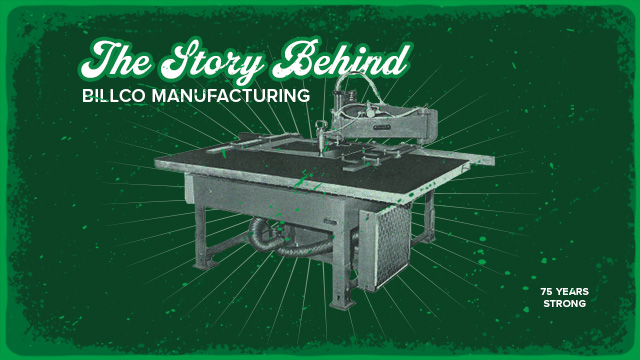
Billco Manufacturing sits in Zelienople, Pennsylvania, in the same place it called home 75 years ago, grounded with the same commitment to doing things right.
Some companies can tell you what they make. Fewer can clearly explain what they’ve changed along the way. Since 1948, Billco Manufacturing has built its story on consistent forward motion: identifying what the glass industry needs next and then building the machinery to meet it.
A Woman with a Vision
In the late 1800s and early 1900s, the company that would become Billco was already in the glass game, producing diamond-tipped hand cutting tools for the industry under the name “Klages.” But it was in the mid-20th century that things really started moving. That foundation in precision glass tooling shaped everything that followed.
In 1948, Ethel Billinger, stepping away from her family’s business, founded Billco Manufacturing with a clear sense of purpose: build equipment that works, stand behind it, and treat the people around you, employees and customers alike, as partners in the work. Ethel was known for her wit and her dedication, working well into her later years, greeting employees each morning and personally handing out paychecks each week. The culture it created took root and never left.
When Ethel retired, her grandson Bill Billinger carried the company forward. The values she established didn’t need to be rewritten. They were already built in.
The 1940s and ’50s: Building the Basics
Billco’s earliest cutting machines addressed a straightforward need: producing round and oval glass for car mirrors, spectacles, and clock faces. These were manually operated machines, with operators guiding a pneumatic cutting head around a template to score the glass before moving it to a break-out table.
As demand shifted toward rectangular glass, Billco responded with the Model 55 Manual Cutter, capable of processing lites from 20×20 inches up to 44×94 inches. The design used a template-and-pivot system; practical, repeatable, and reliable for the production volumes of the era. 
By the early 1950s, Billco introduced Pin-Bar Tables for straight-line cutting: a large table lined with precision-drilled steel strips that gave operators accurate measurement points for hand-scoring. Later in the decade, the powered strip cutter replaced manual effort with a fixed bridge of multiple pneumatic cutting heads and a powered roller system to drive glass underneath, available in widths from 36 to 96 inches.

On the washing side, Billco introduced one of the industry’s first commercial glass washing systems in 1955, at a time when most manufacturers were still cleaning glass by hand or building makeshift machines in-house. Three years later, we tackled the calcium and magnesium buildup that left a chalky residue on dried glass — developing de-ionizing and reverse osmosis tank systems that are now standard practice across the industry.
The 1960s and ’70s: Setting Industry Standards
In 1960, Billco introduced a patented Flip-Top™ washer design that made internal access and maintenance a matter of minutes rather than hours. It was the kind of practical innovation that operators noticed immediately.

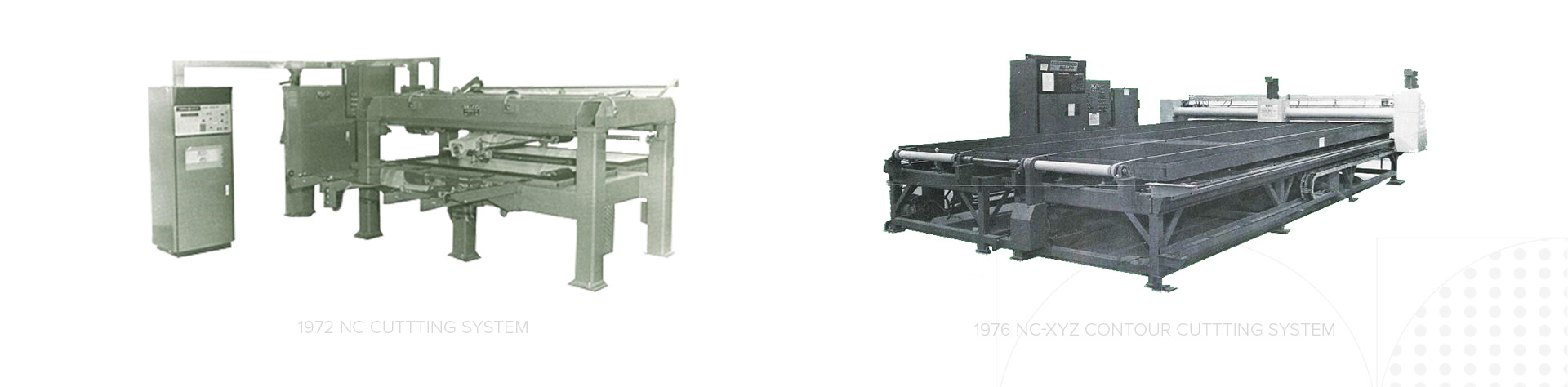
The bigger leap came in 1972. Numerical control technology was already transforming metal milling, but the processing speeds, 100 to 200 inches per minute, were inadequate for glass cutting, which demanded at least 1,000. Hugh Trautmann, a former Boeing engineer who joined Billco, found the path forward. Drawing on aerospace hardware, specifically the ball screws used to control aircraft wing flaps and landing gear, Trautmann engineered a steel frame rigid enough to support a traversing cutting bridge at the speeds glass required.
The result was the world’s first numerical control glass cutting machine: an X-Y axis contour cutter with a 48×96-inch table. The first unit was sold to PPG’s auto glass plant in Greensburg, PA, where it remained in continuous operation until the plant closed in the early 2000s.
Billco continued developing the NC platform through the 1970s. In 1974, we introduced laminated glass processing lines and cleaning systems for advanced vacuum deposition applications. In 1976, we engineered the world’s first 130×204-inch NC-XYZ contour cutter for Tempglass Inc., a large-format cutting and loading system that could produce custom-size glass from oversized stock. The design was widely adopted across the industry in the years that followed.
The 1980s and ’90s: Expanding the Scope
By the mid-1970s, Billco’s washing systems had already moved beyond windows and doors. We supplied cleaning equipment for photovoltaic manufacturing in 1975, and in 1982 provided cleaning and laminating systems for the landmark Solar One project at Sandia Laboratories.
In 1995, Billco introduced the Ultra Series cutting machine, featuring the world’s first high-speed linear motor drive system, developed initially for the automotive glass market. Where NC machines of 1972 targeted 1,000 inches per minute, today’s CNC-controlled Ultra Series machines run at 7,000 to 9,000 inches per minute. The performance gap is one measure of how far the technology has come and how consistently Billco has been driving that progress.
2000 to Present: Automation, Software, and Sustained Innovation
The pace of development accelerated further in the 2000s. In 2002, Billco introduced the world’s fastest crane loading system, paired with the first interactive HMI touchscreen in the industry for operator control. In 2003, we released BatchBan, the world’s first batchless glass optimization software, which has since grown into its own operation under the company, HP3 Software. The following year brought the industry’s first integrated cutting and laser marking system for plant-wide glass identification and traceability, also now managed through HP3 Software.
Subsequent years brought further advances in washing technology: SCR-controlled heating in 2006 to reduce energy and water consumption; BioClean in 2008 for automated washer cleaning; an automatic detergent dosing system in 2015; and the Z-Series washer in 2016, which earned DWM Reader’s Choice Best Equipment recognition in both 2017 and 2023.

On the handling side, 2011 saw the introduction of our Remnant Storage System, automatically saving and cataloging leftover glass pieces for reuse, reducing material waste in a meaningful, practical way. In 2013, we advanced crane loading further with 270-degree rotation and the first decoupled tilt arms for precision grabbing. By 2023, Billco had introduced the industry’s first 7-axis, servo-controlled crane loading system, representing the current state of the art in automated glass handling.
In 2018, we introduced a Data Acquisition and Water Quality Monitoring System for real-time washer performance tracking, closing the loop between equipment operation and process oversight. And in 2021, Billco Teams formed, our distribution partnership extending our product line capacity to provide more to the market.
Built to Last — and to Matter
Billco equipment is engineered with longevity as a design requirement. Our machines routinely remain in production for 25 years or more, which reflects directly in total cost of ownership for our customers. It’s a standard we hold ourselves to because we believe the equipment we put in your facility should still be performing well after your next planning cycle.
But the equipment is only part of what we bring to the table. Since Ethel Billinger walked the floor in Zelienople more than 75 years ago, the operating principle has been the same: we are more invested in your success than in the transaction. That’s the way this company has conducted itself across three generations and it’s not something we’re inclined to change.
Contact Billco Manufacturing to become part of our legacy.

